INNER ATHLETE BLOG
Your Child Doesn’t Need to Lift Heavy to Become Stronger
As a parent, you want your child to feel strong, confident and capable when they play their sport.
But perhaps you’ve watched them:
Get pushed off the ball by stronger athletes
Lose confidence when an exercise feels difficult
Struggle with coordination or movement technique
Work hard without seeing the progress they hoped for
Feel nervous or intimidated about entering a gym
You may know strength training could help, but still wonder whether your child is ready. Will they be expected to lift heavy weights? Are the exercises appropriate for their age? What if they can’t keep up?
These concerns are understandable.
Young athletes don’t need to enter the gym already strong or confident. They need the right environment to learn, practise and improve without being rushed.
That is why the 1x20 method can be a valuable starting point.
What Is 1x20 Strength Training?
The principle is simple: an athlete generally performs one set of approximately 20 repetitions across a broad range of exercises.
A session may include:
Squat and split-squat variations
Hip-hinge movements
Pushing exercises
Rows and pulldowns
Hip bridges
Hamstring and lower-body exercises
Smaller, single-joint movements
This gives young athletes repeated opportunities to learn how their bodies move and become familiar with different exercises.
However, the goal isn’t simply to complete 20 repetitions.
The goal is to perform quality repetitions using an appropriate weight, good control and consistent technique.
Your Child Doesn’t Need to Lift Heavy to Get Stronger
It is easy to assume that effective strength training must involve heavy weights.
For a developing athlete, something more important comes first: learning how to move and lift well.
If your child is still learning to squat, hinge, push or pull, simply adding more weight may reinforce poor movement patterns and reduce their confidence.
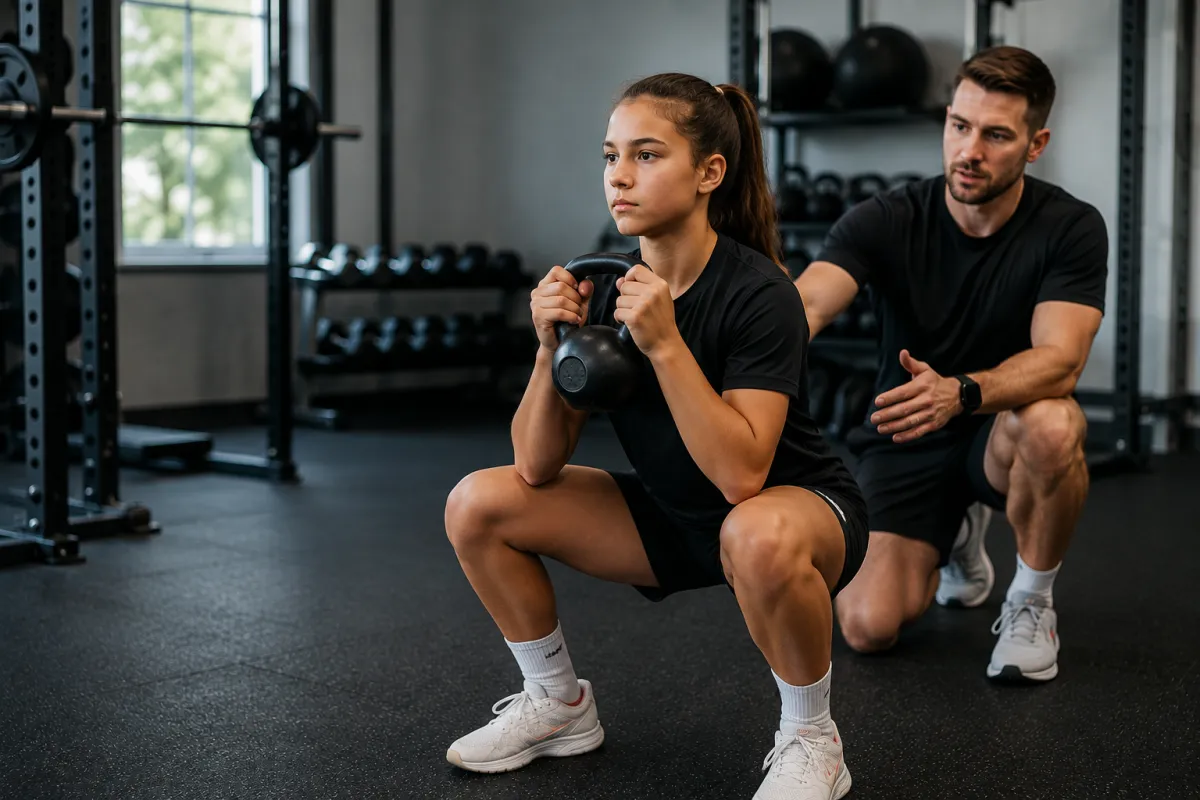
The 1x20 method allows them to practise each movement with a manageable load while focusing on:
Understanding the exercise
Developing coordination and body awareness
Maintaining good technique
Controlling the weight
Becoming comfortable in the gym
As their technique and confidence improve, the exercise or weight can gradually progress.
A movement that once felt awkward starts to feel natural. A weight that once seemed impossible becomes something they know they can handle.
That is how sustainable strength is developed.
Building Confidence Through Small Wins
One of the most valuable outcomes of youth strength training isn’t only physical.
It is the moment your child begins to believe, “I can do this.”
For an athlete who already feels smaller, weaker or less coordinated than their teammates, being pushed into exercises that are too advanced can reinforce the belief that they aren’t good enough.
Starting with an achievable challenge creates a different experience:
Learn → practise → improve → build confidence → progress
Each small win shows your child that consistent effort leads to improvement. Over time, this confidence can extend beyond the gym. They may become more willing to attempt new skills, respond positively to coaching and remain composed when something doesn’t go perfectly in their sport.
The Program Should Adapt to Your Child
Every young athlete develops differently.
Your child may have a different level of strength, coordination, training experience and confidence from the athlete beside them. They may also have particular movements that require more attention.
That is why youth strength training should never be one-size-fits-all.
When working with swimmer Holly, the Inner Athlete coaching team identified an area of her movement that needed further development. Instead of continuing to add weight, her coaches changed the exercise and provided additional feedback to help her improve her movement pattern.
The program adapted to Holly—not the other way around.
This is an important part of Long-Term Athletic Development. Progress isn’t about rushing your child towards the heaviest weight or most advanced exercise. It is about providing the right challenge at the right time.
Sometimes progressing means adding weight. At other times, it means improving control, adjusting an exercise or taking a temporary step back so your child can move forward confidently.
What Parents Should Look For
When choosing a strength program for your child, don’t judge its quality by how hard the session looks or how much weight the athletes lift.
Look for a program that provides:
Coaches who understand developing athletes
Individualised exercises and appropriate starting points
A strong focus on movement quality
Gradual progression based on readiness
A supportive and encouraging environment
A long-term approach to confidence and performance
Your child should be challenged, but they should also understand what they are doing and why.
They should leave training feeling more capable—not overwhelmed or compared with everyone else.
Help Your Child Build Strength and Confidence
Your child doesn’t need to be the strongest athlete in the room.
They need a coach who can meet them where they are, teach them how to move effectively and provide the right challenges as they develop.
Sometimes the most meaningful change isn’t the weight your child can lift. It is watching them attempt something they once avoided and begin to believe they are capable of more.
At Inner Athlete, we help young athletes develop the strength, movement skills and confidence needed to support their sporting goals. Each athlete is coached from their current ability and progresses when they are ready.
Book an Inner Athlete Quick Start Trial and help your child take their first step towards becoming a stronger, more confident and capable athlete.
Want to support your child’s development beyond the gym?
Download our free guide: From Frustration to Confidence: A Parent’s Guide to Helping Young Athletes Become Stronger, Faster and More Confident—Safely and Effectively.

Book A Free Discovery Call
By providing your number you consent to receive marketing/promotional/motification messages from Inner Athlete. Opt-out anytime by replying STOP. Msg & Data rates may apply
Apply Today
Lorem ipsum dolor sit amet, consectetur adipiscing elit, sed do eiusmod
STEP 1
Submit Your Application
Lorem ipsum dolor sit amet, consect adipiscing elit, sed do eiusmod tempor incididunt ut labore et dolore
STEP 2
Go Through The Interview Process
Lorem ipsum dolor sit amet, consect adipiscing elit, sed do eiusmod tempor incididunt ut labore et dolore
STEP 3
Start Coaching
Lorem ipsum dolor sit amet, consect adipiscing elit, sed do eiusmod tempor incididunt ut labore et dolore
Follow Us